
The short answer
Dental implants are a long-term way to replace a missing tooth root. They are not maintenance-free, and they are not permanent in the ordinary sense of that word.
In long-term studies of modern screw-shaped implants, most of the implants that were followed were still present at 10 years. The tooth attached to the implant, usually a crown or a bridge, was replaced or repaired more often than the implant itself. Inflamed gums were common enough, in those same kinds of studies, that cleaning and reviews are part of the treatment rather than an optional extra.
Those are averages from research groups. They are not Brisbane Dental Implants' results, and they do not tell you how long an implant would last in your jaw. Bone, gum health, smoking, medical history, the shape of the prosthesis and whether it is cleaned all move the odds. A clinical examination is the only way to talk about your own situation.
Any surgical or invasive procedure carries risks
Before proceeding, you should seek a second opinion from an appropriately qualified health practitioner. This article is general information. It cannot diagnose a problem or decide whether an implant is suitable for you.
Are dental implants permanent?
No. Calling an implant permanent suggests it will never need repair, never need cleaning beyond a normal toothbrush, and never be lost. That is not how implants behave, and it is not a claim this clinic makes.
People meet the word in advertisements and in conversations about "a permanent tooth". What the treatment can offer, when it is suitable, is a fixed replacement that does not come out at night and does not need the neighbouring teeth to be cut down for a conventional bridge. That is a different promise from "this will last forever without attention".
Australian health advertising rules restrict claims that would create an unreasonable expectation. A fixed lifespan, a clinic success rate held out as a personal forecast, or a description of implants as permanent would be that kind of claim. The more useful question is which part you are asking about, and what would count as a problem along the way.
Healthdirect Australia describes an implant as a metal screw, usually titanium, placed in the jaw where a root used to be, with a crown, bridge or denture attached afterwards. Once it has healed, the day-to-day care looks familiar: brush twice a day, clean between the implant and the neighbouring teeth, and attend reviews. The familiar part is the point. It is looked after. It is not sealed away from the mouth.
The implant and the tooth are different parts
An implant treatment has pieces that are meant to stay and pieces that are meant to be repairable. Mixing them up is how a 10-year study gets quoted as if the crown, the gum and the screw had the same record.
| Part | Role | What time can do to it |
|---|---|---|
| Fixture | The screw in the bone, usually titanium. Zirconia fixtures exist and are chosen only in selected cases. | Designed to stay. It can fail to integrate in the early months, or be lost years later to bone inflammation or, less often, fracture. |
| Abutment | The connector between the fixture and the tooth, unless the crown attaches directly. | Can loosen or, rarely, break. It is a replaceable component, not something to ignore once it moves. |
| Screw | Holds a screw-retained crown or bridge in place. | Can work loose. If the crown was made to be removed, the screw can often be reached. A screw left loose can break. |
| Crown, bridge or denture | The tooth you see and chew on. Materials include zirconia, porcelain and, for some full-arch bridges, acrylic on a stronger frame. | Chips, wears, and is replaced more often than the fixture. A crown is a restoration, not a root. |
| Gum and bone | The living seal around the fixture. | Can stay healthy, become inflamed, or lose bone. Daily cleaning is aimed at this seal. |
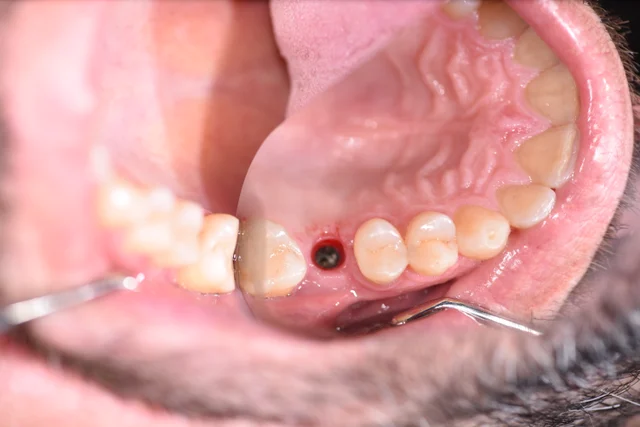
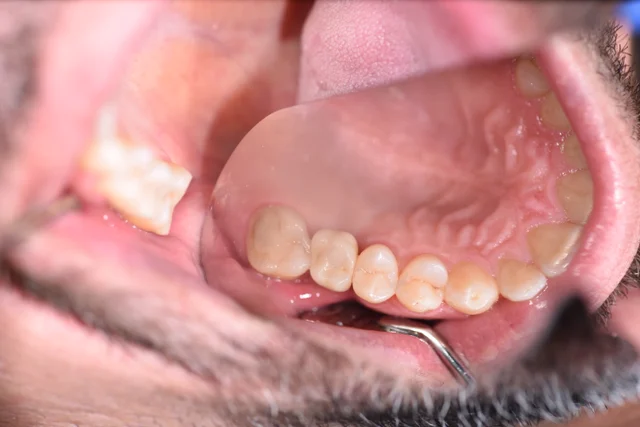
These photographs are from one upper back-tooth case at this practice. The camera angle, lighting and gum position differ between the two views. They are clinical photographs, not a patient story, and they are not a review. More staged photographs are in the smile gallery, with the same limit: a photograph of a fitted crown does not show longevity.
A single tooth implant makes the split easy to see. One fixture, one crown. A bridge on two implants, or a full arch of teeth on several implants, multiplies the screws and the material that can chip, and it changes how you clean. The biology does not become permanent just because more implants were used.
What the studies actually counted
"Survival" in implant research usually means the fixture was still in the mouth at the end of the study. It does not mean the crown was the original one, the gum was healthy, the screw never loosened, or the person was pleased with the tooth. "Success" is stricter, and different papers define it differently. When a website quotes a single percentage, it is worth asking which of those was counted, in whom, and for how long.
These figures are not a forecast
The numbers below come from systematic reviews of other clinics and research groups. They are not Brisbane Dental Implants' results. A confidence interval is the range the analysis treats as compatible with the average of the studies it included. A prediction interval is wider: it is the range a new, similar study might fall into. People who stopped attending also matter. If a review assumes they still have their implants, the percentage looks better than if those missing people are counted more cautiously.
| What was counted | Published estimate | What it does not mean |
|---|---|---|
| Fixture still present at 10 years | Howe, Keys and Richards (2019) pooled 18 prospective studies of modern rough-surfaced screw implants in adults. The main estimate was 96.4% (confidence interval 95.2 to 97.5%). When people lost to follow-up were handled more cautiously, it fell to 93.2% (90.1 to 95.8%), and the prediction interval widened to about 77 to 100%. | Not a personal chance. Not proof the crown or the gum stayed healthy. The cautious analysis shows how much the headline moves when missing patients are not assumed to be fine. |
| Single-tooth fixture still present | Jung and colleagues (2012) estimated 97.2% at 5 years (96.3 to 97.9%) and 95.2% at 10 years (91.8 to 97.2%) for implants supporting single crowns. | Research and specialist settings are over-represented. The 10-year interval is already wider than the 5-year one. |
| Original single crown still in place | The same 2012 review estimated crown survival of 96.3% at 5 years (94.2 to 97.6%) and 89.4% at 10 years (82.8 to 93.6%). | About one crown in ten in that 10-year estimate had been lost or replaced. Chipping and loose screws can happen before a crown is counted as lost. |
| Loose screw or abutment on a single crown | Jung and colleagues estimated a 5-year cumulative incidence of 8.8% (5.1 to 15.0%). Veneer fracture was about 3.5%, and loss of retention about 4.1%. | The range is wide. A loose screw is often repairable. It is also common enough that "set and forget" is the wrong picture. |
| Fixture still present at 20 years | Kupka and colleagues (2024) found fewer studies. Three prospective studies gave about 92% (82 to 97%) before an adjustment for missing patients, and about 78% (74 to 82%) after that adjustment. Five retrospective studies gave about 88% (78 to 94%). | Twenty-year evidence is thinner. The result depends on how people who stopped attending are counted. Follow-up does not finish at 10 years. |
Put the crown row next to the implant row and the practical point is clear. In the single-crown review, the fixture was still there more often than the original crown. The authors' own conclusion was that survival was high and that technical, biological and aesthetic complications were still frequent. Ceramic chipping, a screw that needs tightening, and a gum that bleeds are maintenance, not a footnote.
The same 2019 review found lower 10-year survival in people aged 65 and over in its more cautious analysis. That is a reason to plan reviews, not a rule that an older adult cannot have an implant. Age, medicines and healing are assessed individually. Our guide to who is suitable for dental implants covers that assessment, including bone, gum disease and medical history.
Material is not a shortcut to permanence either. Most fixtures discussed in these reviews are titanium. The implant guide notes that one-piece zirconia implants have encouraging shorter-term data, and that this is not evidence they avoid gum disease better than titanium.
What changes the odds
Failure is not one event. Some fixtures never integrate and are removed in the early months. Others are lost years later. Many "problems" are not loss at all: a chipped crown, a loose screw, or bleeding gums around an implant that is still firm. The factors below show up repeatedly in research and in consensus statements. None of them sets your result on its own.
Gum disease before the implant
A history of periodontitis is one of the more consistent risk indicators for later inflammation around implants. Active gum disease is usually treated before an implant is planned, and the maintenance load is higher afterwards.
Plaque left at the gum line
The gum around an implant responds to bacterial plaque, much as the gum around a tooth does. The implant itself does not decay. The seal around it can still become inflamed.
Missed reviews
Supportive care is part of the evidence, not a bonus. Inflammation is easier to interrupt before bone has been lost. A review also catches a loose screw before it fractures.
Smoking
Smoking is associated with a higher chance of implant complications, including problems in the gum and bone. Stopping is a health decision to make with your clinician. It is not something a web page can weigh for you.
A tooth that is hard to clean
Bulky crowns, bridges tight against the gum, and full-arch bridges with a smooth undersurface all change which brush or floss actually reaches the plaque. Design is a longevity decision, made before the day of surgery.
Bite force and grinding
Heavy bite forces and tooth grinding are linked more often to chipped ceramic and loose screws than to the fixture quietly leaving the bone. A night guard is sometimes discussed. It is not a shield against every complication.
Poorly controlled diabetes, some medicines, and how much bone was present at the start also belong in the consultation. They are not a yes-or-no list you can finish at home. Cement trapped under the gum is another recognised cause of later inflammation, which is one reason some crowns are designed to be screw-retained and retrievable.
The gum can fail while the implant is still there
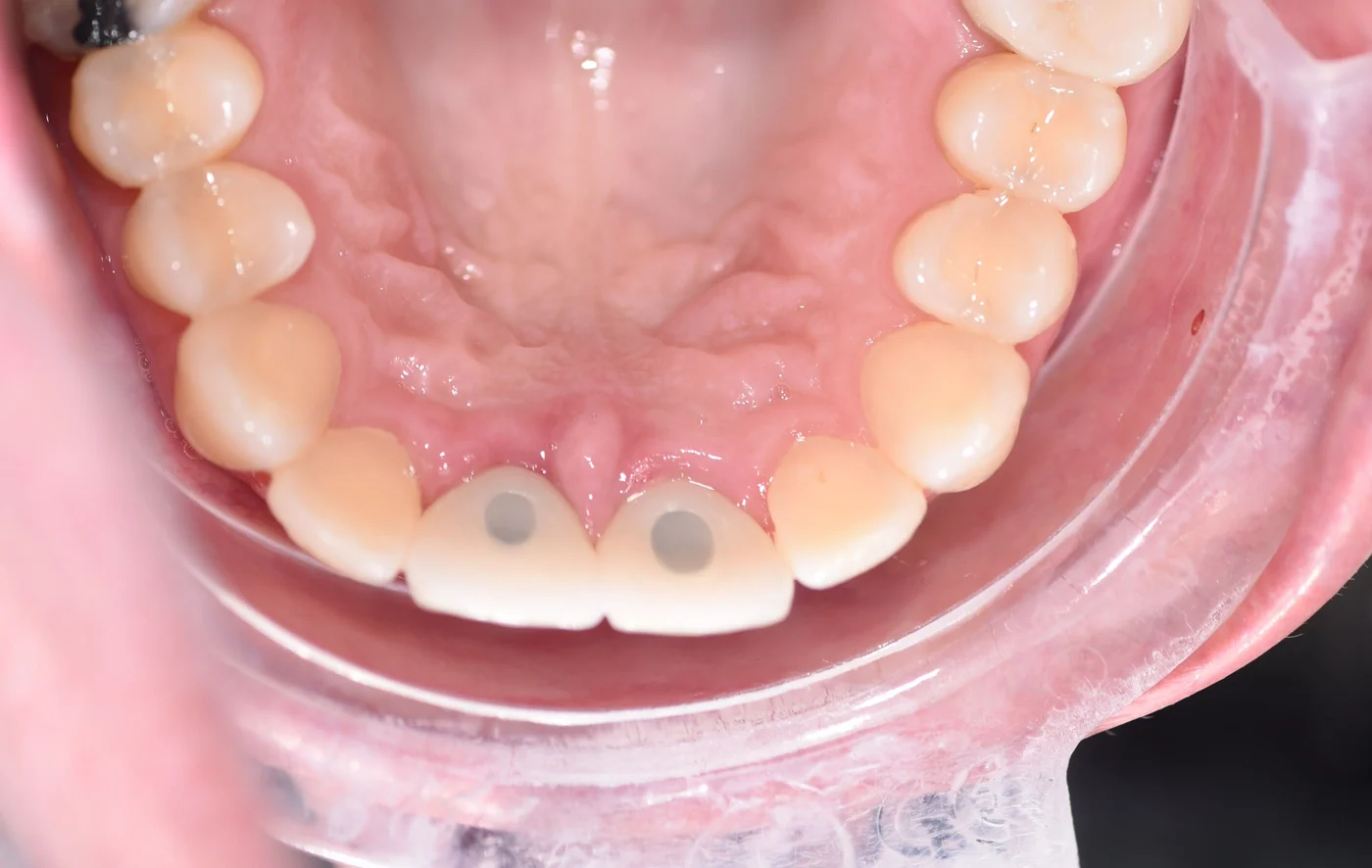
Peri-implant mucositis means the gum around an implant is inflamed, usually with bleeding, without progressive loss of the supporting bone. It is the implant equivalent of gingivitis, and it can often be reversed if the plaque is removed and kept off. Peri-implantitis means that inflammation is accompanied by progressive bone loss. It is harder to treat, and not every implant with bone loss can be kept.
How common these are depends on the definition. Derks and Tomasi (2015) found study estimates ranging from 19% to 65% for mucositis and from 1% to 47% for peri-implantitis. Their pooled averages were about 43% and about 22% of people. A later review found a similar message with slightly different averages: gum inflammation around implants is common, bone-loss disease is less common, and both estimates swing when the threshold for "disease" changes. Prevalence of peri-implantitis also tended to rise the longer implants had been in function.
Do not read 22% as your personal risk. Do read it as a reason the maintenance visit exists. Bleeding is a reason to be examined. It is not, by itself, a diagnosis, and a lack of pain is not a clean bill of health. Peri-implantitis is often quiet until bone has already been lost.
Our page on peri-implantitis and periodontal treatment explains how mucositis and peri-implantitis are assessed, and why gum disease is stabilised before implant planning. The implant guide lists the broader surgical risks, including infection, nerve injury and sinus complications, which are separate from this long-term gum story.
What maintenance actually involves
There is no single interval that suits every mouth. Pocket depth, bleeding, how much plaque is present, smoking, diabetes, a history of bone loss, and whether you can physically reach the area all change the timetable. Someone with a history of periodontitis or a bridge that is awkward to clean is often seen several times a year. Someone with healthy tissues and easy access may be seen less often. The interval is set after an examination. Copying a number from a webpage is how early inflammation gets missed.
At this clinic, implant maintenance and gum care are led by Mr Dennis Han, oral health therapist, working with the dentists who review the bite, the restoration and any x-rays. A maintenance visit is not only a polish.
At a review
The usual checks are bleeding and plaque, the gum margin, whether the crown or bridge is stable, the bite, and whether a screw-retained tooth has started to move. X-rays are taken on a schedule, not necessarily every visit, to look at bone levels. You should also leave knowing how to clean that particular shape.
At home
A usual routine is a soft brush twice a day at the gum line, plus a way to clean between the implant and the next tooth: floss, an interdental brush of the right size, or both. A water flosser can flush the area. It does not replace mechanical cleaning. Under a fixed bridge, the useful tool is the one that actually fits the gap you have.
If the gum bleeds when you clean, book a review and do not abandon the area. Stopping cleaning lets more plaque sit there. The clinician can show a method that reaches the spot without scrubbing the surface off the crown. Metal picks and abrasive pastes are a poor idea on implant components; the specific tools are part of what the visit is for.
Early post-operative reviews are not the same thing as this long-term care, and they are not automatically included forever in a surgical fee. A written plan should say which reviews are included and which cleans, x-rays, repairs or complication visits are charged separately. The cost guide explains how to read a quote that way.
What can be repaired, and what may not
A loose crown on a firm implant is a different problem from an implant that itself moves. Screw-retained crowns can often be removed, the screw replaced or retightened, and the crown put back. A chip can sometimes be smoothed, and sometimes the crown has to be remade. Cemented crowns are harder to remove without damaging them. Inflamed gum without bone loss often settles with professional cleaning and a changed home routine. Bone loss may need further treatment, and some implants are removed. None of these is something to decide from a photograph or a symptom list.
Full-arch teeth need more maintenance, not less
A full upper or lower set of fixed teeth is still a prosthesis on implants. There are more screws, more material to chip or wear, and a surface under the bridge that a normal toothbrush does not reach. The implants can remain while the teeth on the bridge are repaired or, years later, replaced. That is expected maintenance, not a surprise failure of the whole treatment.
You do not unclip a fixed bridge at night. If it is designed to be removed for a professional clean or a repair, the dentist removes it. Acrylic teeth on a full-arch bridge wear differently from a solid zirconia bridge, and the quote should say which one is planned, because the repair path is different. The All-on-4 and full mouth implant pages cover the planning differences. They are not simpler versions of a single crown, and their longevity still depends on cleaning access.
The same caution applies to any percentage you see attached to a full-arch brand name. Ask whether the number is implants still present, original teeth still present, or people who needed no repairs. Those three answers diverge.
Signs that need a review
Contact the clinic if you notice bleeding that continues, swelling, pus, a bad taste, gum shrinking away from the crown, a click or movement in the tooth, a change in the bite, or food trapping that is new. Pain is not required for peri-implantitis, so the absence of pain is not reassurance.
A loose feeling can be the crown, the screw, or the fixture. Only an examination can tell those apart. Do not keep chewing on a tooth that has started to rock while you wait for it to "settle".
If there is facial swelling, difficulty breathing or swallowing, bleeding you cannot control, or pain that is spreading or worsening quickly, that needs urgent in-person care. Call the clinic on (07) 3523 1764 during opening hours. If it is severe, or the clinic is closed, call 000 or go to a hospital emergency department.
Questions worth asking
- Which part of this plan is the fixture, and which part is the crown, bridge or denture?
- Is the restoration screw-retained, so it can be removed, or cemented?
- What cleaning tools will actually fit, and who will show me?
- How often will I be reviewed in the first year, and what would shorten that interval later?
- Which reviews are in the quote, and what does a new crown, a new screw, or treatment of gum problems cost later?
- If I have had gum disease, how does that change the maintenance plan?
- What are the alternatives, including a bridge, a denture, or leaving the gap, and what upkeep do those need?
- What happens if the fixture does not integrate, or if the crown chips in five years?
A bridge on natural teeth and a removable denture also wear out, and they have their own risks. The comparison is not "implants last, everything else does not". It is which risks and which maintenance you are taking on. Suitability, including whether grafting is needed first, is a separate decision from longevity.
Common questions
How long do dental implants last?
There is no fixed lifespan. In reviews of modern screw-shaped implants, most fixtures followed for 10 years were still present. Howe, Keys and Richards (2019) estimated 96.4% in the main analysis and 93.2% when people lost to follow-up were counted more cautiously. The crown is replaced more often than the fixture. These are research averages, not a prediction for one person and not this clinic's results.
Are dental implants permanent?
No. They are a long-term replacement for a tooth root, not a maintenance-free tooth. The crown or bridge can chip, wear or be replaced, screws can loosen, and the gum can become inflamed while the fixture remains. Describing an implant as permanent would overstate what treatment can offer.
Does the crown last as long as the implant?
Often it does not. A 2012 review of implant single crowns estimated that about 95% of the implants were still present at 10 years, compared with about 89% of the original crowns. Loose screws and chipped ceramic can occur earlier, while the implant stays in place. The ranges around those estimates are wide.
Can a dental implant last 20 years?
Some do. Twenty-year studies are fewer. A 2024 review reported about 92% survival in three prospective studies before adjusting for missing patients, about 78% after that adjustment, and about 88% in five retrospective studies. Whether an individual implant reaches 20 years cannot be promised from those averages.
Do dental implants decay?
The implant does not decay, because it is not a tooth. The gum and bone around it can become inflamed, and the crown can chip or wear. Brushing, cleaning between the teeth, and professional reviews are what protect the seal around the implant.
How often should an implant be checked?
There is no universal interval. Bleeding, plaque, smoking, diabetes, previous gum disease, bone loss and how hard the prosthesis is to clean all change it. Some people are seen several times a year. The interval should be set at a clinical review, not copied from an article.
Can a loose implant crown be repaired?
Sometimes. If the crown is screw-retained and the implant is firm, the crown can often be removed and the screw retightened or replaced. A crown that rocks because the fixture itself is loose is a different problem and needs examination. Do not keep chewing on a tooth that has started to move.
What makes an implant more likely to need treatment later?
Research most consistently links later gum and bone problems with a history of periodontitis, plaque left around the implant, and missed maintenance. Smoking and a prosthesis that is difficult to clean also matter. Grinding is linked more often to chips and loose screws. None of these factors decides an individual case without an examination.
Sources
The clinical figures on this page come from the reviews below. Patient-facing Australian and US guidance is included for the description of the procedure, everyday care and surgical risks. Guidelines on health advertising are included because "permanent" is a claim, not a neutral description.
- Howe, Keys and Richards, 2019. Long-term (10-year) dental implant survival. Journal of Dentistry.
- Jung and colleagues, 2012. Survival and complications of implant single crowns. Clinical Oral Implants Research.
- Kupka and colleagues, 2024. A 20-year meta-analysis of dental implant survival. Clinical Oral Investigations.
- Derks and Tomasi, 2015. Peri-implant health and disease: a systematic review of current epidemiology. Journal of Clinical Periodontology.
- Berglundh and colleagues, 2018. Peri-implant diseases and conditions: 2017 World Workshop consensus report.
- healthdirect Australia: Dental implant, including everyday care and complications.
- US Food and Drug Administration: Dental implants, benefits and risks.
- Ahpra: Advertising hub for regulated health services.
Want this mapped to your mouth?
A consultation can look at the gum, the bite, cleaning access and whether an implant is even the right comparison. It cannot promise a lifespan.