
Good site conditions
The site needs enough bone height and width, adequate gum tissue, no active infection and enough space between neighbouring teeth. A CBCT scan helps assess root positions, nerve location and sinus proximity.
Replace one missing tooth with an implant, abutment and custom crown without shaping the neighbouring teeth. Start with a free consultation at our Bulimba clinic.
A single dental implant replaces the root and visible tooth structure of one missing tooth. The implant fixture is placed in the jawbone, then restored with an abutment and custom implant crown once the site has healed. The crown is shaped to fit the bite and sit beside the neighbouring teeth.
This guide covers how the procedure works, how long it takes, what it costs, how it compares with a bridge or denture, and the risks worth understanding before you decide.
This treatment is often considered when one tooth has been lost through trauma, decay, root fracture, gum disease or a failed root canal. It may also be considered when a tooth cannot be predictably restored and extraction is planned. The timing depends on the reason for tooth loss, infection risk, bone volume and gum shape.
A single implant does not require trimming the adjacent teeth in the way a conventional bridge can. However, it is still surgery, and the surrounding teeth, gum and bite must be healthy enough to support a stable result.
A single implant is most appropriate when the missing tooth space, bone, gum and bite can support an implant crown that is easy to clean and maintain.
If the site is not ready, your clinician may discuss socket preservation, delayed placement, orthodontic space management, a bridge or a removable temporary tooth.
At Brisbane Dental Implants, suitable site-ready single implant cases start from $3,995 before any applicable health fund rebate. A written quote is provided after examination and imaging.
For suitable site-ready cases, the starting bundle includes implant placement, the abutment, a standard full-contour zirconia crown, consultation, CBCT imaging, healing reviews and diagnostic X-rays. A $200 records fee applies only if you choose to take the consultation records away.
Extraction, bone grafting, sinus-related planning, temporary restorations, gum grafting, sedation, custom abutments and replacement of failing adjacent dentistry can change the total fee.
Compare the full staged plan, not just the headline fee. The dental implants cost Brisbane page explains common inclusions and exclusions.
The exact sequence varies depending on whether the tooth is already missing, needs extraction, or requires grafting first.
The dentist checks the gap, adjacent teeth, gum health, bite and medical history. A scan is used to assess bone and nearby anatomy.
If the tooth is still present, extraction may be performed with socket preservation where appropriate. In some cases implant placement is delayed to allow healing.
The implant is placed in a planned position so the crown can emerge through the gum in a cleansable and functional way.
A temporary tooth may be used for appearance during healing, but it must not overload the implant. Healing commonly takes a few months.
The final crown is fitted after the implant is ready to restore. Ongoing reviews check the bite, crown, gum health and cleaning access.
A single tooth implant is one option, not the only option. Your dentist should explain reasonable alternatives.
| Consideration | Single implant | Conventional bridge | Removable denture |
|---|---|---|---|
| Adjacent teeth | Left untouched | Usually shaped for crowns | May need clasps or rests |
| Surgery required | Yes | No | No |
| Typical time to finish | Several months | A few weeks | A few weeks |
| Jawbone at the gap | Loading may help maintain bone | Bone under the gap still resorbs | Bone under the gap still resorbs |
| Cleaning | Brush and floss like a tooth | Needs threading under the pontic | Removed for cleaning |
| If it fails | Implant may be replaced or site regrafted | Both abutment teeth are affected | Usually remade or relined |
| Upfront cost | Higher | Moderate | Lower |
Most single implant cases run over several months rather than several weeks, because the implant needs time to integrate with bone before it can carry a crown. These are general ranges, not a schedule for your case.
Examination, 3D CBCT scan, photographs and records. Where an extraction or grafting is needed first, this is where the sequence is decided.
If the tooth is still present it may be removed, sometimes with socket grafting. Healing before implant placement commonly takes two to four months.
The fixture is placed in a single appointment, usually under local anaesthetic. Most people return to ordinary activity within a day or two.
The bone bonds to the implant surface. This commonly takes around three to six months, and longer where the site was grafted or bone quality is poor.
Once integration is confirmed, an impression or digital scan is taken and the custom crown is made and fitted, typically over two or three visits.
When a tooth still needs removing, the implant can sometimes be placed at the same appointment. Whether that is appropriate depends on the socket, not on preference.
Risks include surgical, aesthetic, restorative and maintenance issues. These should be discussed before treatment starts.
These matched photographs show an upper back tooth before and after its final implant crown is fitted. The implant is already present in the earlier photograph. Outcomes vary, and camera angle, lighting and gum position differ.
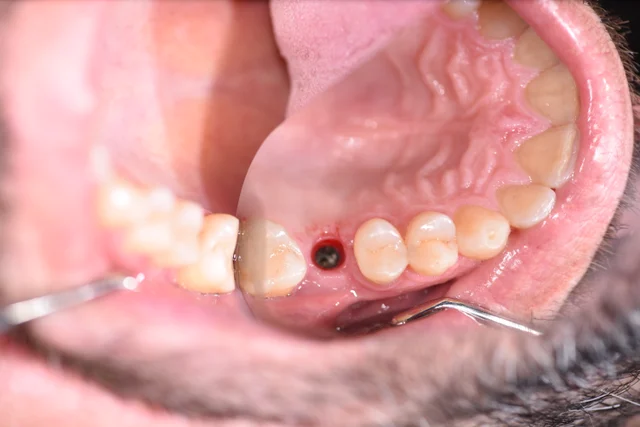 Before final crown
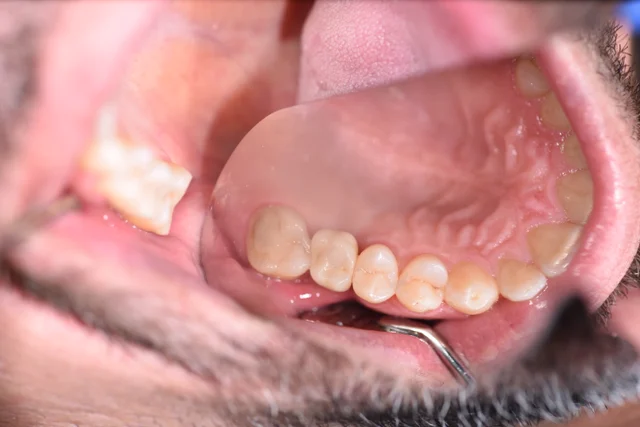 After crown fitting
For more examples across treatment categories, visit the smile gallery. No result can be assured for a future patient.
Single tooth implant planning at Brisbane Dental Implants may involve Dr Virginia Han, Dr Sae Mi Bok or another treating dentist depending on the clinical situation. The plan should identify the position of the implant, the proposed crown design, risks, alternatives and maintenance needs before you consent.
Return to the implant hubA single dental implant is planned differently depending on whether the missing tooth is visible in the smile or used mainly for chewing.
The reason this matters is simple: the implant has to be placed where the final crown needs support, not merely where bone happens to exist. A poorly positioned implant can make the crown bulky, difficult to clean, visually uneven or overloaded. Digital planning, CBCT imaging and a restoration-first approach help reduce these compromises.
Patients also need a temporary tooth plan. A front tooth gap may need a more aesthetic temporary solution, while a back tooth may be left out of heavy chewing during healing. The right temporary option balances appearance, comfort and protection of the implant site.
A single tooth gap can look simple, but small details can change the plan.
Bring any old x-rays, previous root canal records, orthodontic history, trauma history or information about when the tooth was removed. If the tooth is still present, tell your dentist when symptoms started, whether swelling has occurred and whether antibiotics or emergency treatment have been needed.
For a front tooth, photos from before the tooth was damaged or removed can help with shape and colour planning. For a back tooth, information about clenching, grinding, cracked teeth or broken fillings helps the dentist assess bite load. If you use a night guard or splint, bring it to the appointment.
Useful questions include whether the neighbouring teeth are healthy, whether orthodontic space correction is needed, whether grafting is likely, what temporary tooth will be used, and how the crown will be cleaned. Ask the dentist to show you where the implant is planned on the CBCT scan and how that position supports the final crown.
Some implants can be placed at the extraction visit, but many cases are delayed for healing or grafting. Infection, thin bone, gum shape and front tooth aesthetics all influence timing.
Temporary tooth options may include a clear retainer tooth, temporary denture, bonded temporary or provisional crown in selected cases. The temporary must protect the healing implant site.
The implant crown itself cannot decay, but nearby teeth can, and the gum and bone around the implant can become inflamed. Cleaning and maintenance remain essential.
It can be more demanding aesthetically because gum level, bone thickness, tooth colour and smile line are highly visible. Back teeth often have higher chewing load considerations.
Some extras policies may contribute to parts of implant treatment depending on your cover, waiting periods and item numbers. Ask your fund for an estimate using the written treatment plan.
Implants do not decay, and many function for well over a decade. Longevity depends on gum and bone health, bite forces, smoking, diabetes control, cleaning and regular review. The crown on top is a separate component and may need repair or replacement sooner than the implant itself.
Neither is better in every case. An implant avoids shaping the neighbouring teeth and loads the bone at the gap, but requires surgery and months of healing. A bridge is faster and avoids surgery, and can make sense when the adjacent teeth already need crowns. The comparison table above sets out the trade-offs.
Three components. The fixture is the titanium or zirconia post placed in the jawbone and takes the place of the root. The abutment is the connector that sits on the fixture and passes through the gum. The crown is the visible tooth, made to match the shade and shape of the teeth beside it.
Placement is carried out under local anaesthetic, and sedation is available where appropriate. Discomfort afterwards varies between people and is usually managed with simple pain relief. Swelling and tenderness for a few days is common; your clinician will explain what is expected and what is not.
Often, but the ridge will have resorbed to some degree since the tooth was lost, so a CBCT scan is needed to measure what bone remains. Some long-standing gaps need grafting first — see the bone grafting guide for how that is assessed and staged.
Read the implant cost guide, bone grafting guide and main dental implants Brisbane hub.
Request a free initial implant consultation to discuss your options. Our team will contact you to arrange a time. A $200 records fee applies only if you choose to take consultation records away.
You do not need to choose a treatment before contacting us. Your initial consultation includes a clinical assessment and 3D CBCT imaging where clinically required.