
Planning and surgery
Dr Virginia Han, our Principal Dental Surgeon and Lead Implant Clinician, leads implant planning. Surgical placement is performed by Dr Han or Dr Sae Mi Bok.
Explore fixed teeth supported by four implants at our Bulimba clinic. Start with a free consultation and 3D CBCT scan to compare full-arch options, costs and suitability for your mouth.
From $19,000 per arch for suitable cases.
Extractions, grafting and sedation cost extra. A written quote confirms your treatment and bridge design.
Implant planning led by Dr Virginia Han, BDSc Hons (UQ).
Initial Full-Arch Consultation
Consultation and scan are free. A $200 records fee applies only if you choose to take the consultation records away.
Request Free ConsultationOur team will contact you to arrange a time.
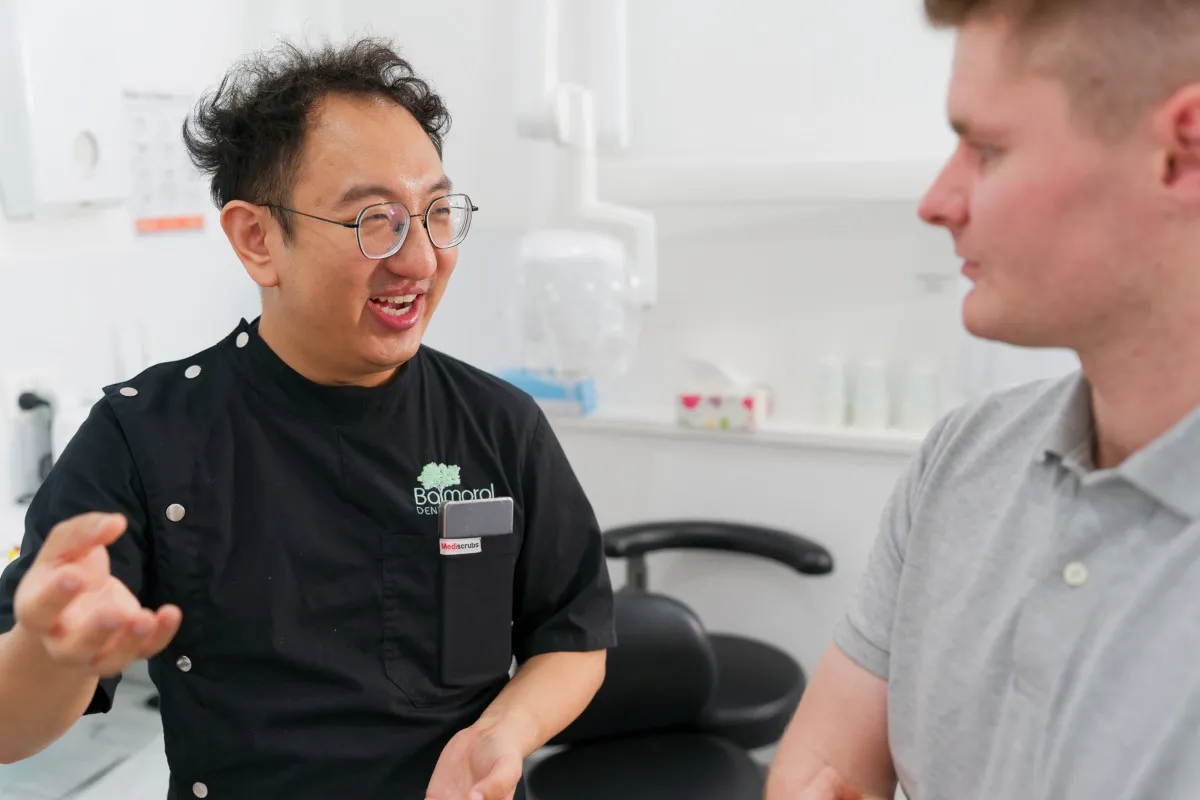
All-on-4 is a full arch implant concept where four implants support a fixed bridge replacing the teeth in one upper or lower arch. The two rear implants are angled to make use of available bone and reduce the need for grafting in selected cases. It may be considered for patients who have lost all teeth in an arch, wear unstable dentures, or have failing teeth that cannot be predictably restored.
The phrase can sound simple, but the clinical planning is detailed. The team must assess the jawbone, smile line, lip support, speech, gum display, bite, cleaning access and the type of final bridge. Some patients are better suited to All-on-6, implant-retained dentures, staged grafting, or retaining strategic natural teeth.
All-on-4 is not one appointment only. Even when a temporary bridge is fitted close to surgery, the final prosthesis is usually made after healing and review.
Suitable cases start from $19,000 for one upper or lower arch, before any health fund rebate. Treating both arches requires its own plan and quote. Your fee depends on the preparation needed and the temporary and final bridge design.
From $19,000 per arch
Four implants support one fixed bridge. Your dentist confirms the implant system, bridge material and treatment stages in your written quote.
Request a Written Treatment Plan| Included | Initial consultation, 3D CBCT scan, implant surgery, temporary teeth and a final full-arch fixed bridge for the agreed treatment plan. |
|---|---|
| Additional costs | Extractions, bone grafting and sedation, if needed. Different bridge materials or more complex treatment can change the fee. |
| Confirm in your quote | The temporary and final bridge materials, included review visits, surgical guide and any fees for ongoing cleaning, repairs or treatment of complications. |
| Optional records | $200 only if you choose to take the consultation records away. The initial consultation and scan remain free. |
A fixed bridge is removed by a dental professional when needed; you do not remove it each night. The starting fee is not a quote for every patient. Read our implant cost guide and payment options before comparing plans.
Planning, implant surgery and restoration are coordinated at our Bulimba clinic, with on-site CBCT imaging and a digital dental laboratory.
Meet the clinical team or explore our Bulimba facility.
Suitability depends on clinical findings, not the number four alone. A full arch plan should be based on 3D imaging, restorative design and health risk assessment.
Your sequence may differ depending on whether teeth need removal, whether infection is present and how the temporary bridge is designed.
Clinical photos, scans, CBCT imaging, bite records and medical history are reviewed. The dentist assesses whether All-on-4, All-on-6 or another option is appropriate.
The replacement teeth are planned before surgery. This includes smile line, tooth position, speech space, cleaning access and how the temporary teeth will be fitted.
Unrestorable teeth may be removed, implants placed and a temporary bridge fitted if the case is suitable. The temporary bridge protects the healing plan and is not the final restoration.
The implants integrate over several months. You will need a modified diet, hygiene instruction and reviews to check healing, bite and prosthesis fit.
The final bridge is made after healing. Material options may include zirconia, titanium-acrylic or other designs depending on function, aesthetics and repair planning.
The temporary teeth support the healing stage. Your final bridge is fitted after the team has reviewed healing, gum changes and your bite. Neither stage is maintenance-free.
Read more about implant maintenance and gum inflammation. Your treatment plan should explain who to contact for problems and which follow-up services are included.
Full arch treatment is significant dental surgery and prosthetic rehabilitation. Consent should include the risks that apply to your case.
All-on-4 is well known, but it is not the only way to restore a full arch. The most suitable design depends on bone, bite, cleaning ability and prosthetic goals.
The final bridge material also matters. Acrylic teeth on a titanium framework can be repairable and may suit some bite patterns, while zirconia can offer different wear and aesthetic properties. No material is maintenance-free. The treating clinician should explain the likely repair pathway, cleaning routine and review schedule for the material chosen.
Compare full-mouth implant options, including fixed bridges and removable implant-retained dentures.
A full arch consultation is most useful when the dentist can understand your dental history, denture experience, medical risk and expectations for fixed teeth.
Bring any dentures, night guards, old models, recent x-rays, previous periodontal records and a medication list. If you have had problems with dentures, note whether the issue is movement, sore spots, speech, gagging, appearance, chewing, dry mouth or loss of confidence eating in public. These details help the team plan tooth position, lip support and cleaning access.
Ask whether the proposed All-on-4 design is upper, lower or both arches; whether any teeth can be retained; whether a temporary bridge is planned; what diet is needed during healing; and what material is proposed for the final bridge. Also ask how the bridge will be cleaned and how often it should be professionally reviewed.
It is reasonable to ask why four implants are being recommended instead of five, six or a removable implant denture. The answer should refer to your CBCT scan, bone distribution, bite forces, smile design, prosthesis length and maintenance needs. That discussion is often more important than the label attached to the procedure.
Also ask about consent documents and the cooling-off period you need to make a decision. Full arch treatment can involve removing remaining teeth, which is irreversible. You should understand what will happen if you decide not to proceed, whether a transitional denture is available, and how urgent the treatment really is. A careful plan gives you time to compare options without pressure, especially when treatment affects both function and appearance.
Suitable cases start from $19,000 per arch, including consultation, CBCT imaging, implant surgery, temporary teeth and a final fixed bridge for the agreed plan. Extractions, grafting and sedation are additional. Your written quote confirms bridge materials, review visits and any further fees. This is a starting fee for one arch, not a price for both jaws.
The initial consultation and 3D CBCT scan are free. A $200 records fee applies only if you choose to take those records away. Request a consultation and our team will contact you to arrange a time.
All-on-4 describes a bridge supported by four implants in one arch. Treating both upper and lower arches requires separate planning for each. Full-mouth treatment may use All-on-4, All-on-6 or other implant and denture options.
Some suitable patients receive a temporary fixed bridge close to surgery. This depends on implant stability, bone quality, bite risk and surgical findings.
The bridge is usually fixed to the implants and removed by the dental team for maintenance when needed. It is not removed nightly like a conventional denture.
Sometimes angled implants reduce the need for grafting, but not always. Bone volume, sinus position, nerve position and prosthetic design determine what is suitable. Learn more about bone preparation in our detailed bone grafting guide.
Cleaning usually involves brushing around the bridge, cleaning underneath with interdental aids or water flossing, and regular professional maintenance.
Read the full mouth guide, cost guide, bone grafting guide, main implant hub, and our comparison of overseas vs local treatment for complex staged care.
Brisbane Dental Implants is at Suites 10 & 11 / 204 Oxford St, Bulimba QLD 4171. On-site patient parking is available.
Open Monday to Sunday, 8:30 am–5:30 pm. Call (07) 3523 1764 or view contact and access details.
Request Free ConsultationA consultation is an opportunity to compare the proposed bridge, alternatives, maintenance needs and total fees before deciding.
Our clinical photo gallery shows other implant restoration examples. Photographs do not predict your outcome or establish that the same treatment is suitable for you.
Any surgical or invasive procedure carries risks. Before proceeding, seek a second opinion from an appropriately qualified health practitioner.
Nobel Biocare: the All-on-4 treatment concept explains the four-implant approach. For general benefits, risks and maintenance, see the FDA’s dental implant patient information. These resources do not determine your suitability or the implant system in your treatment plan.
Request a free initial implant consultation to discuss your options. Our team will contact you to arrange a time. A $200 records fee applies only if you choose to take consultation records away.
You do not need to choose a treatment before contacting us. Your initial consultation includes a clinical assessment and 3D CBCT imaging where clinically required.