

The short answer
Neither a dental bridge nor a dental implant is the right replacement for every gap. A conventional bridge is fixed to the natural teeth on either side. A single implant replaces the missing root in the jaw and carries its own crown. One asks more of the neighbouring teeth. The other asks for surgery, healing time and care of the gum around the implant.
In a widely cited review, a conventional tooth-supported bridge and an implant single crown were still present at 10 years at almost the same rate, about 89%. That does not mean they fail in the same way, and it does not mean either figure is your result. Decay and nerve problems sit with the bridge. Screw loosening, chipped ceramic and gum inflammation sit more often with the implant. The choice is which of those risks fits the teeth you still have.
Any surgical or invasive procedure carries risks
Before proceeding, you should seek a second opinion from an appropriately qualified health practitioner. Preparing teeth for a bridge is also irreversible. This article is general information. It cannot tell you which option suits your mouth.
A bridge is not always the alternative to an implant
People usually mean a tooth-supported bridge: crowns on the teeth beside a gap, joined to a false tooth called a pontic. healthdirect Australia describes it that way. The bridge is fixed. You do not take it out at night. The teeth that hold it are usually filed down so the crowns can fit, including teeth that were otherwise healthy.
An implant-supported bridge is a different treatment. The false teeth are held by implants, not by the natural teeth next door. It still has a bridge to clean underneath, but the surgical and maintenance questions are implant questions. This clinic's pages on implant types and full-arch bridges cover that path. The comparison below is the common one: a tooth-supported bridge against a single implant and crown, for a gap that has a tooth on at least one side.
| Question | Tooth-supported bridge | Single implant and crown |
|---|---|---|
| What holds the new tooth? | The natural teeth beside the gap, usually one on each side. | A fixture in the jaw, with its own crown. The neighbours usually stay unprepared. |
| What has to be healthy enough? | The supporting teeth, their nerves, their roots and the gum around them. | The bone and gum in the gap, and your ability to heal after surgery. See who may be suitable. |
| Surgery | No implant placement. The supporting teeth are reshaped. A local anaesthetic is still used. | The fixture is placed into the jaw. Nerves, sinuses and neighbouring roots are part of the planning. |
| Usual timing | Often more than one visit over a few weeks, sometimes with a temporary bridge. Decay or gum treatment can come first. | Often several months from placement to the final crown. Grafting or other care makes it longer. |
| Later problems that show up most often | Decay on the supporting teeth, nerve problems, cement failure, and a bridge that loosens. | Chipped ceramic, a loose screw, and inflammation of the gum or bone. The crown is replaced more often than the fixture. |
A conventional bridge spends the neighbouring teeth
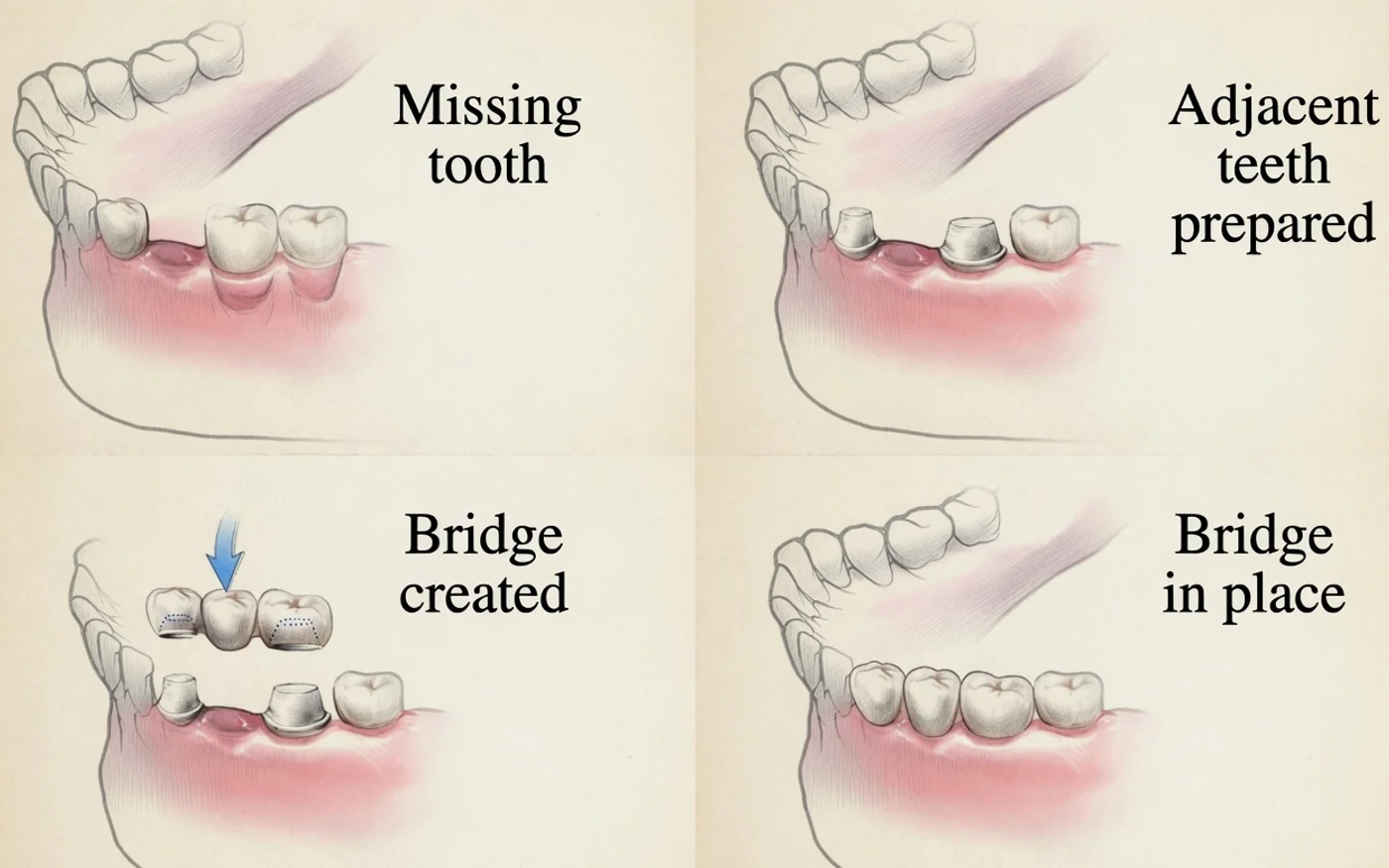
The drawing is the sequence. First there is a gap. Then the teeth on either side are reduced to stumps, not merely polished. A laboratory makes one bridge: a crown for each prepared tooth, joined to a false tooth in the middle. Once it is cemented, the row can look ordinary. Under the outer crowns, those teeth have already been cut down. A crowned tooth can later need root canal treatment, a new crown, or extraction. If one supporting tooth fails, the whole bridge often fails with it.
That trade can still be reasonable. A tooth that is already heavily filled or crowned may have less untouched tooth to lose, and using it as a support can replace the gap without implant surgery. healthdirect notes that the supporting teeth need to be strong enough, and that bridges often fail because those teeth decay or the cement gives way. The examination is what decides whether "strong enough" is true, not a photograph of a gap.
Leaving the gap has consequences too. Teeth can tip into the space, and a tooth in the opposite jaw can over-erupt. Those changes are not certain, and they are not a reason to treat a gap you are comfortable leaving. They are a reason to look at the bite before you decide that doing nothing is free of effect.
An implant leaves the neighbours alone, and involves the jaw
A single implant stands in the gap. The teeth beside it are not cut down to hold the new tooth. That is the main reason an implant is discussed when those teeth are sound. It is not a reason to call an implant the better treatment. The fixture needs enough bone, healthy enough gum, and a plan that keeps it clear of nerves, sinus and adjacent roots. Some people need grafting first. Some are better served by keeping a tooth, wearing a denture, or using a bridge.
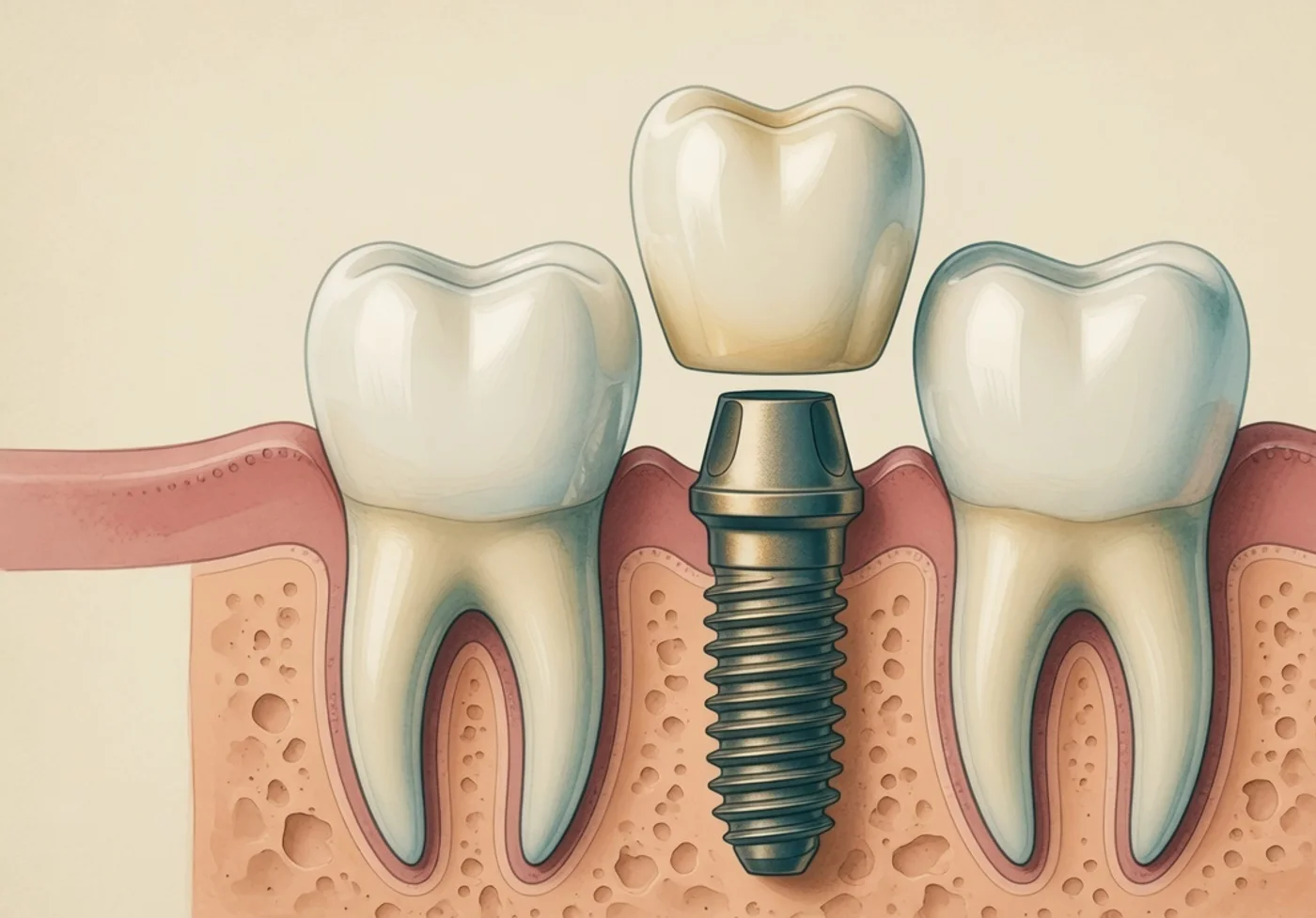
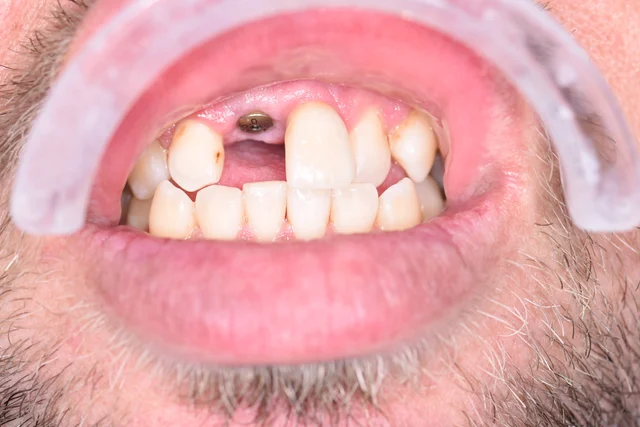
The final tooth is still a crown. It can chip, and the screw that holds it can loosen, while the fixture stays in the bone. Our article on how long dental implants last separates those parts. Read that before treating a single percentage as a lifespan.
A single tooth implant is planned differently from a bridge on several implants. If the gap is long, or there is no tooth at the back of it, one implant may not be the whole plan. More than one fixture, a different span, or a denture may be discussed after the scan.
Resin-bonded bridges and cantilevers
A resin-bonded bridge, sometimes called a Maryland bridge, sticks a framework to the back of a neighbouring tooth instead of crowning it all the way around. Less tooth is removed. That does not make it maintenance-free. Thoma, Sailer, Pjetursson and colleagues (2017) estimated survival of about 91.4% at 5 years (confidence interval 86.7 to 94.4%) and about 82.9% at 10 years (73.2 to 89.3%) across the studies in that review. The common problem was debonding: the bridge coming unstuck, estimated at about 15% by 5 years (10.9 to 20.6%). In that same review, a single retainer and a front-tooth site did better than a back-tooth site or several retainers. Those are research averages. A debonded wing can often be recemented. Repeated debonding is a reason to reconsider the design, not a small inconvenience to ignore.
A cantilever bridge hangs the pontic off one end only. It is sometimes used when there is no tooth on the other side of the gap. In the 2007 comparison below, cantilever tooth-supported bridges had lower 10-year survival than bridges held at both ends. A cantilever loads the supporting tooth in a different way. It is a specific plan, not a shortcut version of a two-ended bridge.
Joining a natural tooth to an implant in the same bridge is another design, and the same review estimated lower 10-year survival for it than for a bridge on teeth alone or a crown on an implant alone. It is not the ordinary way to replace one missing tooth.
What the studies actually counted
Pjetursson and colleagues (2007) pooled studies of fixed tooth replacement and estimated how often each type was still present. "Still present" is survival of the prosthesis. It is not a year-by-year promise, it is not freedom from repairs, and it is not this clinic's results. The studies available to that review are older than today's materials. Newer ceramics can chip or fracture differently. Use the table to see that the headline gap between a conventional bridge and an implant crown was small, and that other designs diverged.
| Restoration | About 5 years | About 10 years |
|---|---|---|
| Conventional bridge on natural teeth | 93.8% | 89.2% |
| Implant single crown | 94.5% | 89.4% |
| Bridge held only by implants | 95.2% | 86.7% |
| Cantilever bridge on natural teeth | 91.4% | 80.3% |
| Bridge joining a tooth and an implant | 95.5% | 77.8% |
The same review found a different pattern of trouble underneath those similar survival figures. For conventional bridges, the frequent problems were biological: decay and loss of pulp vitality in the supporting teeth. For implant restorations, technical problems were more common: chipped ceramic, loose screws or abutments, and loss of retention. Among people with an implant-supported bridge, about 38.7% had some complication by 5 years, compared with about 15.7% for a conventional tooth-supported bridge. Many of those implant complications were repairable. A higher repair rate is not the same thing as the tooth being lost. It does mean "set and forget" is the wrong picture for either option.
A later review of implant single crowns (Jung and colleagues, 2012) again put the crown, rather than the fixture, near 89% at 10 years. The fixture was still there more often than the original crown. If someone quotes only the higher number, ask whether they mean the screw in the bone or the tooth you chew on.
Time, surgery and cost are different questions
A bridge is often faster
healthdirect describes more than one visit: the supporting teeth are prepared, a mould or scan is taken, and the final bridge is fitted later. A temporary bridge may fill the gap meanwhile. Decay, gum disease or a weak supporting tooth can add appointments before any of that starts. "Faster" assumes the neighbouring teeth are ready.
An implant is often staged
Many single implants take several months, because the bone has to hold the fixture before the final crown is fitted. A same-day temporary tooth is only for selected cases. Extraction, grafting or infection control extends the timeline. Avoiding surgery is a legitimate reason to prefer a bridge. It is not a sign that the bridge has no clinical cost.
This clinic publishes a starting fee for one specific implant plan: $3,995 for a suitable, site-ready single implant and zirconia crown, before health fund rebates. Extraction, grafting, sedation and other care are extra. That number is not a bridge fee, and it is not the fee for an implant that needs extra procedures. A bridge is quoted from the teeth that would support it, the material, and whatever those teeth need first. Health fund rebates differ between the two. The fair comparison is two written plans, each listing what is included now and what is likely to be repaired later. The implant cost guide shows how to read an implant quote. It does not price a tooth-supported bridge.
Do not rank them by the first number
A bridge can later need root canal treatment, a new crown, or replacement if a supporting tooth fails. An implant can later need a new crown, a new screw, or treatment of the gum. The smaller quote on day one is not the smaller cost of owning the tooth.
Cleaning, and what looseness means
A bridge joins teeth together, so ordinary floss often cannot pass between them. Cleaning is under the pontic and around the crowned supports: a floss threader, superfloss, or an interdental brush, shown on the bridge you actually have. Decay at the edge of a crowned supporting tooth is a common reason bridges are lost. Bleeding or a bad taste is a reason to be examined, not a reason to stop cleaning.
An implant crown is cleaned at the gum line, and between it and the next tooth. The fixture does not decay. The gum and bone around it can become inflamed. Daily cleaning and reviews are the maintenance, not an optional extra. Mr Dennis Han leads implant maintenance and gum care at this clinic. A loose implant crown and a loose bridge are both reasons to stop chewing on that side and book a visit. Neither one should be left to "tighten itself".
A removable partial denture remains the other common alternative. It usually avoids implant surgery and avoids crowning the neighbours, and it comes out for cleaning. Stability and the way it clasps the remaining teeth are the trade. The short comparison on the implant guide sets the three options side by side.
Questions worth asking
- Are the teeth beside this gap intact, filled, crowned, or already in need of treatment?
- If we use a bridge, how much of those teeth is removed, and what happens to the plan if one of them fails later?
- Is there a tooth at both ends of the gap, or would a bridge be a cantilever?
- Is there enough bone for an implant without grafting, and what are the surgical risks in this site?
- How many visits, and how many months, does each written plan take?
- What is included in each fee now, and what is the likely cost of a repair in five or ten years?
- How will I clean under a pontic, or around an implant, with the tools that fit this mouth?
- What happens if I leave the gap, and for how long is that reasonable?
Bring the list to the examination. A consultation can look at the neighbouring teeth, the bite and a scan. It still cannot rank the options for you from a webpage.
Common questions
Is a dental bridge better than an implant?
Not as a general rule. A conventional bridge and an implant single crown were still present at similar 10-year rates in one major review, about 89%. They put different teeth and tissues at risk. A bridge usually reshapes the neighbours. An implant usually does not, and it requires surgery. The suitable option depends on the examination.
Does a dental bridge damage the neighbouring teeth?
A conventional bridge usually requires those teeth to be filed down for crowns, even when they were healthy. They can later decay, need root canal treatment, or fail, and the bridge often fails with them. A resin-bonded bridge removes less tooth, but it comes unstuck more often. An implant is the option that usually leaves the neighbours unprepared.
How long does a bridge last compared with an implant?
There is no personal lifespan for either. Pjetursson and colleagues (2007) estimated about 89.2% of conventional bridges and about 89.4% of implant single crowns still present at 10 years. Cantilever bridges and bridges joining a tooth to an implant were lower in that review. Survival is not the same as a repair-free decade, and these are not this clinic's results.
Can I have a bridge if there is no tooth behind the gap?
A conventional bridge needs a support at each end. Without a back tooth, the alternatives include a cantilever, an implant, or a denture. A cantilever loads one supporting tooth differently, and older reviews estimated lower 10-year survival than a bridge held at both ends. The bite and the supporting tooth decide whether a cantilever is even discussable.
What is a resin-bonded bridge?
It bonds a wing to the back of a neighbouring tooth instead of crowning the whole tooth. Less enamel is removed. A 2017 review estimated about 91% still present at 5 years and about 83% at 10 years, with debonding in about 15% by 5 years. Front-tooth designs with one retainer did better in that review than back-tooth designs. Coming unstuck is a known maintenance issue, not a rare surprise.
Is an implant bridge the same as a tooth bridge?
No. An implant-supported bridge is held by fixtures in the jaw, not by crowns on natural teeth. You still clean under the pontics, and the implants still need reviews. It is planned like implant treatment, including surgery and bone assessment, not like a conventional bridge.
How do I clean under a dental bridge?
The crowns are joined, so floss often cannot pass straight down between them. A floss threader, superfloss or a small interdental brush is used under the false tooth and around the supports. Your dentist or oral health therapist should show you on the bridge you have. Decay on a supporting tooth is a common reason to be seen early.
How should I compare the cost?
Ask for a written plan for each option, with what is included now and what repairs may cost later. This clinic's published $3,995 starting fee is for a suitable, site-ready single implant and zirconia crown before rebates, not for a bridge. Extraction, grafting and other care are extra. A bridge fee depends on the supporting teeth and is quoted separately.
Sources
The comparison figures come from systematic reviews. They are not Brisbane Dental Implants' results. Patient-facing Australian descriptions of a bridge and an implant are included so the everyday steps match public guidance. A fixed lifespan, or a claim that one option suits everyone, would overstate what either treatment can offer.
- Pjetursson and colleagues, 2007. Survival and complications of tooth-supported and implant-supported fixed prostheses. Clinical Oral Implants Research.
- Thoma, Sailer, Pjetursson and colleagues, 2017. Resin-bonded fixed dental prostheses after at least 5 years. Clinical Oral Implants Research.
- Jung and colleagues, 2012. Survival and complications of implant single crowns. Clinical Oral Implants Research.
- healthdirect Australia: Dental bridge, including preparation of the neighbouring teeth and cleaning.
- healthdirect Australia: Dental implant, including surgery, healing and everyday care.
- Ahpra: Advertising hub for regulated health services.
Want both options mapped to this gap?
A consultation can look at the neighbouring teeth, the bite and whether an implant is even available in the bone. It will not rank them from a slogan.